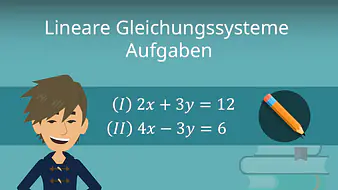
Du möchtest bei der Anwendung des Gleichsetzungsverfahrens in Mathe sicherer werden? Hier Video findest du verschiedene Übungsaufgaben und den Lösungsweg dazu!
Leichte Aufgaben zum Gleichsetzungsverfahren
Hier findest du erstmal ein paar einfachere Aufgaben zum Lösen linearer Gleichungssysteme durch das Gleichsetzungsverfahren.
-
Stelle die Funktionen nach x um
a) 2x + 3y = 6
b) 4x – y = 5
c) x + 2y = 3x
Lösung:
Tipp: Du kannst die Lösung einfach als Bruch angeben.
a)
2x + 3y = 6 | -3y
⇔ 2x = 6 – 3y | ÷2
⇔ x = (6 – 3y) / 2
b)
4x – y = 5 | +y
⇔ 4x = 5 + y | ÷4
⇔ x = (5 + y) / 4
c)
x + 2y = 3 | -2y
⇔ x = 3 – 2y
-
Stelle die Funktionen nach y um
a) x + 4y = 8
b) 3x – 2y = 6
c) 5x + y = 10
Lösung:a)
x + 4y = 8 | -x
⇔ 4y = 8 – x | ÷4
⇔ y = (8 – x) / 4
b)
3x – 2y = 6 | -3x
⇔ -2y = 6 – 3x | *(-1)
⇔ 2y = -6 + 3x | ÷2
⇔ y = (3x – 6) / 2
c)
5x + y = 10 | -5x
⇔ y = 10 – 5x -
Gib die Lösung des Gleichungssystems an
a) I: x = 4
II: x = 4 – y
b) I: y = 3
II: y = 2 + x
c) I: z = 4
II: z = 10 – 2x
Lösung:
a)
Setze I und II gleich:
4 = 4 – y | -4
⇔ 0 = -y | *(-1)
⇔ 0 = y
Durch I weißt du:
x = 4
Lösung: x = 4, y = 0
b)
Setze I und II gleich:
3 = 2 + x | -2
⇔ 1 = x
Durch I weißt du:
y = 3
Lösung: x = 1, y = 3
c)
Setze I und II gleich:
4 = 10 – 2x | -10
⇔ -6 = -2x | ÷(-2)
⇔ 3 = x
Durch I weißt du:
z = 4
Lösung: x = 3, z = 4
Schwere Aufgaben zum Gleichsetzungsverfahren
Jetzt geht es weiter mit ein paar schwierigeren Aufgaben. Solltest du Probleme haben, decke die Lösung Schritt-für-Schritt auf, oder schau dir das Gleichsetzungsverfahren nochmal an.
Hinweis: ÷ 2 = * (1 / 2)
-
Löse das Gleichungssystem
a) I: 4x – 3y + 2 = 5
II: 2x + y – 4 = 1
b) I: 3x + 5y – 7 = 4
II: 4x – 2y + 6 = 2
Lösung:
a) Stelle beide Gleichungen nach x um:
I: 4x – 3y + 2 = 5 | -2
⇔ 4x – 3y = 3 | +3y
⇔ 4x = 3 + 3y | ÷4
⇔ x = (3 + 3y) / 4II: 2x + y – 4 = 1 | +4
⇔ 2x + y = 5 | -y
⇔ 2x = 5 – y | ÷2
⇔ x = (5 – y) / 2
Setze I und II gleich:
(3 + 3y) / 4 = (5 – y) / 2 | *4 *2
⇔ 2 * (3 + 3y) = 4 * (5 – y)
⇔ 6 + 6y = 20 – 4y | +4y -6
⇔ 10y = 14 | ÷10
⇔ y = 14 / 10
⇔ y = 7 / 5
Setze y = 7 / 5 in II ein:
x = (5 – (7 / 5)) / 2
⇔ x = ((25 / 5) – (7 / 5)) / 2
⇔ x = (18 / 5) / 2
⇔ x = 18 / 10
⇔ x = 9 / 5
Lösung: x = 9 / 5, y = 7 / 5
b)
Stelle beide Gleichungen nach x um:I: 3x + 5y – 7 = 4 | +7
⇔ 3x + 5y = 11 | -5y
⇔ 3x = 11 – 5y | ÷3
⇔ x = (11 – 5y) / 3II: 4x – 2y + 6 = 2 | -6
⇔ 4x – 2y = -4 | +2y
⇔ 4x = 2y – 4 | ÷4
⇔ x = (2y – 4) / 4
⇔ x = (y – 2) / 2
Setze I und II gleich:
(11 – 5y) / 3 = (y – 2) / 2 | *2 *3
⇔ 2 * (11 – 5y) = 3 * (y – 2)
⇔ 22 – 10y = 3y – 6 | +10y +6
⇔ 28 = 13y | ÷13
⇔ y = 28 / 13
Setze y = 28 / 13 in II ein:
x = ((28 / 13) – 2) / 2
⇔ x = ((28 / 13) – (26 / 13)) / 2
⇔ x = (2 / 13) / 2
⇔ x = 2 / 26
⇔ x = 1 / 13
Lösung: x = 1 / 13, y = 28 / 13
-
Stelle die Funktionen nach y um und löse das System
a) I: 2x + 3y – 6 = 7
II: x – 2y + 4 = 3
b) I: 5x – y + 3 = 8
II: 2x + 4y – 8 = 5
Lösung:
a)
Stelle beide Gleichungen nach y um:I: 2x + 3y – 6 = 7 | +6
II: x – 2y + 4 = 3 | -4
⇔ 2x + 3y = 13 | -2x
⇔ 3y = 13 – 2x | ÷3
⇔ y = (13 – 2x) / 3
⇔ x – 2y = -1 | -x
⇔ -2y = -1 – x | ÷(-2)
⇔ y = (1 + x) / 2
Setze I und II gleich:
(13 – 2x) / 3 = (1 + x) / 2 | *2 *3
⇔ 2 * (13 – 2x) = 3(x + 1)
⇔ 26 – 4x = 3x + 3 |+4x -3
⇔ 23 = 7x
⇔ x = 23 / 7
Setze x = 23 / 7 in II:
y = (1 + (23 / 7)) / 2 ⇔ y = ((7 / 7) + (30 / 7)) / 2
⇔ y = (30 / 7) / 2
⇔ y = 30 / 14
⇔ y = 15 / 7
Lösung: x = 23 / 7, y = 15 / 7
b)
Stelle beide Gleichungen nach y um:I: 5x – y + 3 = 8 | -3
II: 2x + 4y – 8 = 5 | +8
⇔ 5x – y = 5 | -5x
⇔ -y = 5 – 5x | *(-1)
⇔ y = 5x – 5
⇔ 2x + 4y = 13 | -2x
⇔ 4y = 13 – 2x | ÷4
⇔ y = (13 – 2x) / 4
Setze I und II gleich:
5x – 5 = (13 – 2x) / 4
⇔ 4 * (5x – 5) = -2x + 13
⇔ 20x – 20 = -2x + 13 | +2x +20
⇔ 20x + 2x = 13 + 20
⇔ 22x = 33
⇔ x = 33 / 22
⇔ x = 3 / 2
Setze x = 3 / 2 in I:
y = 5 * (3 / 2) – 5
⇔ y = (15 / 2) – 5
⇔ y = (15 / 2) – (10 / 2)
⇔ y = 5 / 2
Lösung: x = 3 / 2, y = 5 / 2
-
Textaufgabe
a) Zwei Gärten liefern zusammen 40 kg Gemüse pro Tag. Garten A liefert täglich 4 kg weniger als Garten B. Wie viel liefert jeder Garten pro Tag?
b) Eine Fabrik produziert an zwei Standorten insgesamt 1000 Einheiten pro Woche. Standort 1 produziert 200 Einheiten mehr als Standort 2. Wie viele Einheiten werden an jedem Standort produziert?
c) Ein Händler verkauft insgesamt 150 Produkte pro Monat. Produkt A wird 30 Einheiten weniger verkauft als Produkt B. Wie viele Einheiten von jedem Produkt werden verkauft?
Lösung:
a)
Stelle die Gleichungen auf:
I: A + B = 40
II: A = B – 4
Setze II in I ein:
(B – 4) + B = 40
⇔ 2B – 4 = 40 | +4
⇔ 2B = 44 | ÷2
⇔ B = 22
Setze B = 22 in II ein:
A = 22 – 4
⇔ A = 18
Lösung: Garten A liefert 18 kg, Garten B liefert 22 kg pro Tag.
b)
Stelle die Gleichungen auf:
I: S1 + S2 = 1000
II: S1 = S2 + 200
Setze II in I ein:
(S2 + 200) + S2 = 1000
⇔ S2 + 200 + S2 = 1000
⇔ 2S2 + 200 = 1000 | -200
⇔ 2S2 = 800 | ÷2
⇔ S2 = 400
Setze S2 = 400 in II ein:
S1 = 400 + 200
⇔ S1 = 600
Lösung: Standort 1 produziert 600 Einheiten, Standort 2 produziert 400 Einheiten pro Woche.
c)
Stelle die Gleichungen auf:
I: A + B = 150
II: A = B – 30
Setze II in I ein:
(B – 30) + B = 150
⇔ B – 30 + B = 150
⇔ 2B – 30 = 150 | +30
⇔ 2B = 180 | ÷2
⇔ B = 90
Setze B = 90 in II ein:
A = 90 – 30
⇔ A = 60
Lösung: Produkt A verkauft 60 Einheiten, Produkt B verkauft 90 Einheiten pro Monat.
Studyflix vernetzt: Hier ein Video aus einem anderen Bereich
Nach Beantwortung speichern wir deine Antwort, um Studyflix zu verbessern. Mehr dazu erfährst du in unserer Datenschutzerklärung.
Zusammenfassung — Gleichsetzungsverfahren Aufgaben
Hier siehst du die wichtigsten Grundlagen zusammengefasst:
Du kannst dir die Übersicht auch hier kostenlos herunterladen!

Einsetzungsverfahren
Diese Aufgaben sind dir schon leicht gefallen? Dann schau dir doch als Nächstes das Einsetzungsverfahren an. Denn auch damit kannst du lineare Gleichungssysteme einfach lösen!
